
The single line item that most often breaks a first-time importer's margin on a bubble tea shipment is cold-chain freight that never needed to happen. Most bubble tea ingredients ship perfectly well at ambient temperature in standard dry containers, and paying for refrigerated freight out of caution can add USD 2,000-5,000 per container with no quality benefit. This guide walks through the shipping-mode decision for each major ingredient category, the documentation that matters at customs, and the cost math that separates disciplined importers from the ones bleeding on logistics.
Cold Chain vs Ambient: The Cost Reality
A standard 20-foot dry container from Taiwan to Los Angeles runs roughly USD 2,800-3,500 in ocean freight as of Q1 2026, before port fees and last-mile. The same route in a 20-foot reefer (refrigerated container) runs USD 5,500-7,500 — roughly a 2× premium. For a 40-foot container the gap widens further because reefer capacity is tighter on high-demand routes.
On top of ocean freight, cold chain carries three invisible costs. Power during pre-cooling, transit, and port hold adds USD 400-800 per container. Cold-storage warehousing at origin and destination runs 2-3× ambient rates. And reefers must be pre-booked earlier than dry containers, which locks a buyer into tighter production windows. For a distributor moving USD 2M of bubble tea ingredients annually, picking the wrong mode on even 10% of shipments is a USD 40,000-60,000 leak.
The discipline is to ship ambient by default and cold-chain only when the ingredient category actually requires it. Below is how that decision plays out SKU by SKU.
Which Ingredients Actually Need Cold Chain
The table below maps the most-shipped bubble tea ingredient categories to the correct mode. "Ambient" means standard dry container, 15-30°C. "Cool" means temperature-controlled dry at 12-18°C. "Chilled" means reefer at 2-8°C. "Frozen" means reefer at -18°C or below.
| Ingredient | Correct Mode | Why |
|---|---|---|
| Dried tapioca pearls | Ambient | Shelf-stable sealed for 12-18 months |
| Instant pearls (vacuum-packed) | Cool or chilled | Syrup crystallization risk above 25°C |
| Non-dairy creamer (sealed) | Ambient | Moisture-barrier bags handle tropical transit |
| Milk tea powder (all-in-one) | Ambient | Moisture-proof carton holds up to 40°C |
| Sugar-based fruit syrups | Ambient | High Brix = self-preserving |
| Fresh fruit purees | Chilled or frozen | Fermentation risk above 10°C |
| Tea leaves | Ambient (climate-controlled preferred) | Oxidation-sensitive but not temperature-critical |
| Popping boba | Chilled | Alginate membrane weakens at warm temperature |
| Jelly toppings (sealed cans) | Ambient | Retort-processed, fully shelf-stable |
| Dairy-containing creamer | Chilled | Regulatory and quality |
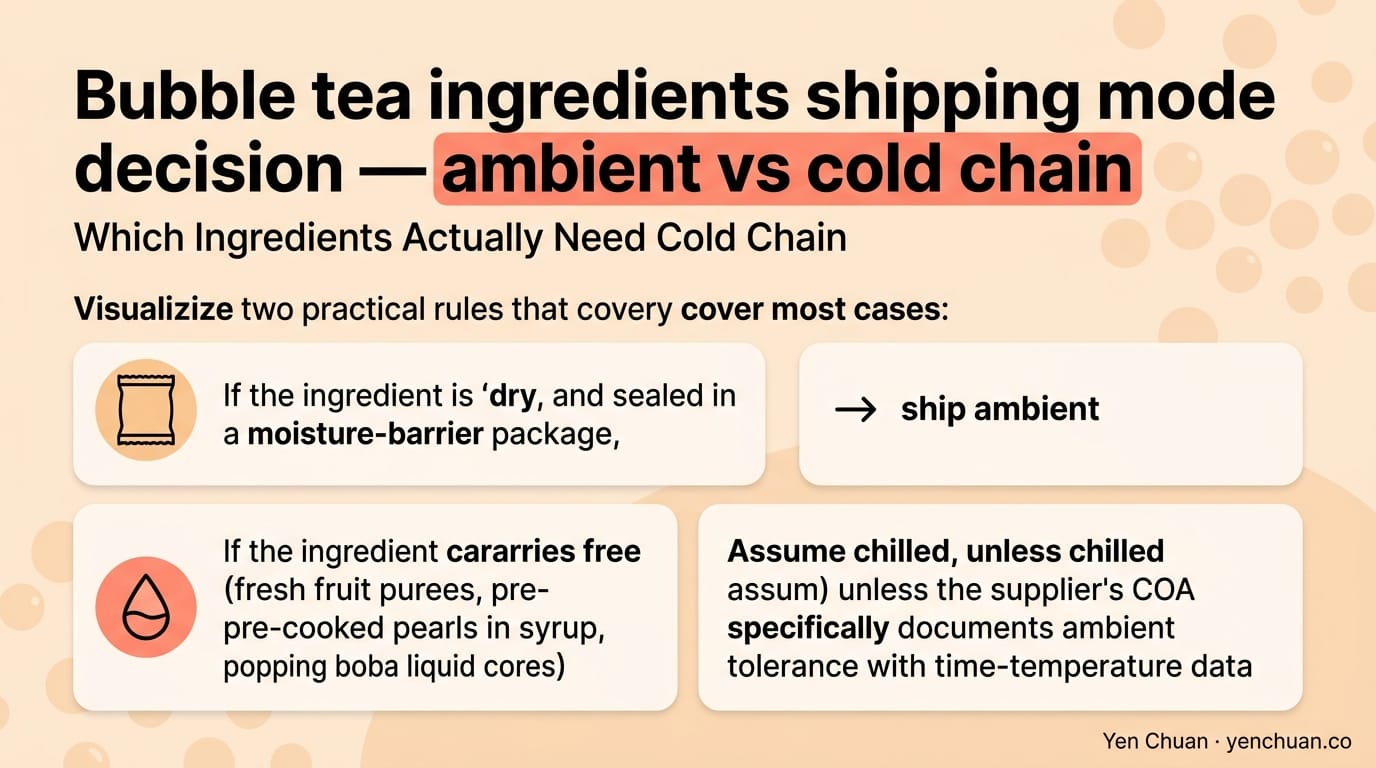
Two practical rules cover most cases. First, if the ingredient is dry and sealed in a moisture-barrier package, ship ambient. Second, if the ingredient carries free water (fresh fruit purees, pre-cooked pearls in syrup, popping boba liquid cores), assume chilled unless the supplier's COA specifically documents ambient tolerance with time-temperature data.
The Three Questions Every Importer Should Ask the Supplier
Before the booking goes to the freight forwarder, three supplier-side questions lock the shipping decision.
First: "What is the tested temperature tolerance for this SKU, and what's the supporting data?" A legitimate supplier can produce accelerated-stability study results — typically a 40°C-for-30-days test with post-test sensory and microbial panels. If the answer is a shrug or "it should be fine," assume the ingredient needs cooler shipping than the carton suggests.
Second: "What is the time-to-destination limit at each mode?" Non-dairy creamer ambient-tested for 60 days doesn't survive 90 days of slow-steam routing through a hot Southeast Asian transhipment port. Ocean freight from Kaohsiung to Rotterdam runs 35-45 days; add 10-15 for customs and inland; now you're at 55-60 and the safety margin is thin. Match transit time to tested shelf life, not to label claim.
Third: "Do you provide time-temperature data loggers on the shipment?" Single-trip loggers cost USD 25-40 and write a verifiable transit record. For ambient shipments on routes that cross equatorial or desert regions, loggers are cheap insurance against a claim dispute. Taiwan exporters increasingly include them on customer request, especially for first-time routes to Indonesia, the Gulf, or tropical African markets.
Documentation: What Actually Travels With the Shipment
Shipping mode also changes the paperwork. Ambient shipments require the standard commercial invoice, packing list, bill of lading, COA, and any import-specific documents (FDA prior notice for US, BPOM registration for Indonesia, JAKIM halal certificate where applicable). Reefer shipments add three more: a pre-cooling certificate from the shipping line, a temperature data log for the full transit, and any country-specific cold-chain declarations.
For US imports, FSVP (Foreign Supplier Verification Program) documentation applies regardless of shipping mode, but inspectors give extra attention to cold-chain SKUs because the failure modes are more consequential. The FDA labeling guide for bubble tea ingredients covers FSVP-adjacent documentation in more detail. For Southeast Asia routing, our Singapore-Malaysia-Indonesia entry guide walks through regional regulatory surfaces that shape mode selection.
Ocean vs Air Freight: When the Rule of Thumb Breaks
Most bubble tea ingredient shipments move by ocean — air freight is typically 5-8× the cost per kilogram and rarely justified for dry goods. The exceptions are narrow but real.
Air makes sense when a chain runs short on a signature SKU and a lost-sales calculation beats freight cost, when a new store opening needs stocking faster than a 30-day ocean window, or when a time-temperature-sensitive lot (fresh fruit puree, premium tea on opening launch) cannot tolerate the transit window ocean requires. Otherwise, ocean wins every time. Our Milk Tea Supplier Guide has a longer discussion of negotiating ocean freight through the supplier versus through a third-party freight forwarder.
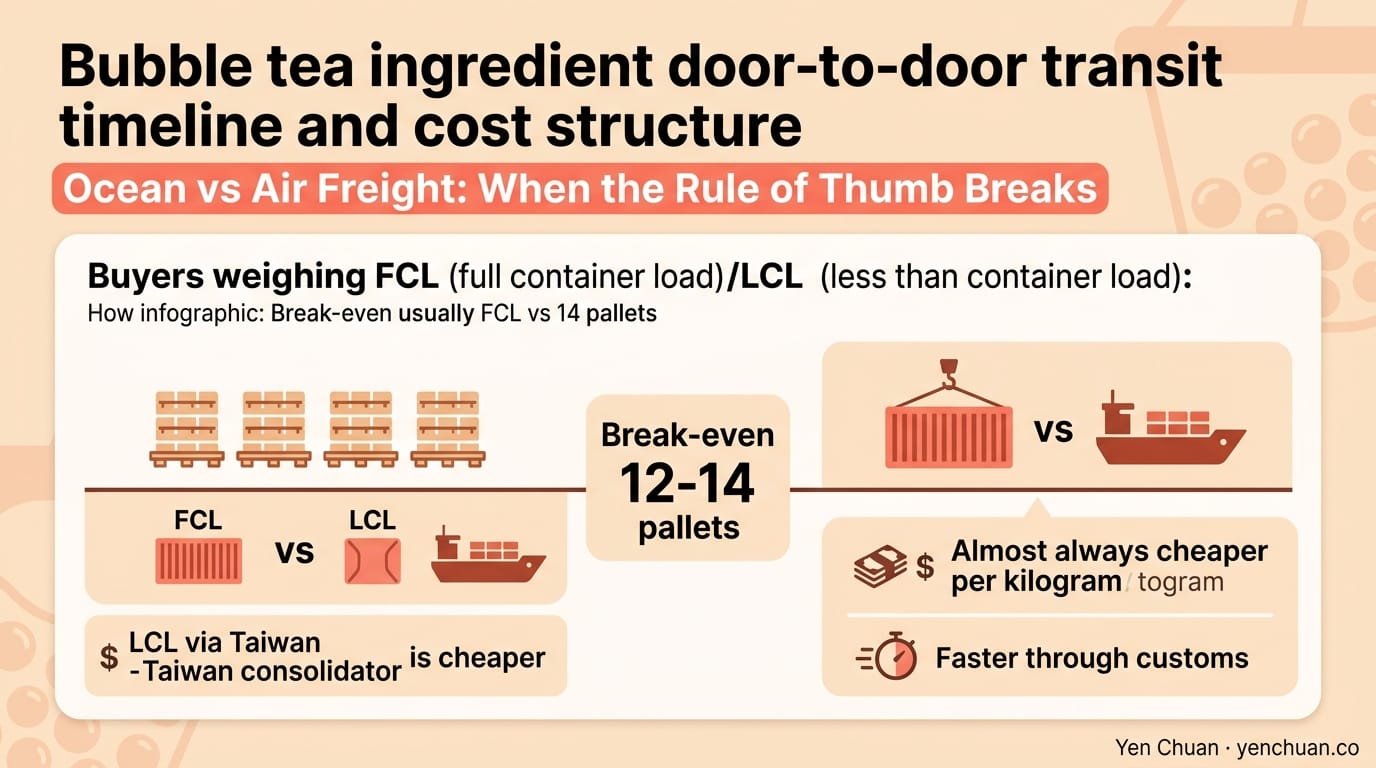
For buyers weighing FCL (full container load) versus LCL (less than container load), the break-even is usually 12-14 pallets. Below that, LCL via a Taiwan consolidator is cheaper; above that, FCL is almost always cheaper per kilogram and faster through customs.
Route-Specific Considerations
The right mode also depends on the lane. Taiwan-to-US West Coast is the cleanest ocean route in the world for food ingredients — 14-21 days, predictable temperature, dense reefer capacity at both ends. Taiwan-to-Gulf (Jeddah, Dubai) crosses equatorial waters and is 28-40 days; cool shipping is worth considering for creamers and powders that will land in extreme ambient markets. Taiwan-to-Africa via Singapore transhipment can hit 45-55 days and consistently fails ambient tolerance for anything not fully moisture-sealed.
A practical pattern for Asia-based importers: use ambient FCL for 80-85% of volume, cool for creamers and specialty tea when the destination warehouse doesn't have a cool-dry zone, and chilled only for the genuinely perishable 5-10%. For full container load economics and supply strategy, see our Taiwan vs China vs Southeast Asia sourcing comparison and the Flavor Powders & Bases catalog for SKU-level mode guidance.
Authority Citations
- International Maritime Organization — Container Shipping Standards
- FDA — FSVP for Importers of Food
- World Bank — Logistics Performance Index
- GCCA — Global Cold Chain Alliance Best Practices
- Drewry — Container Freight Rate Index
About Yen Chuan
Yen Chuan has been at the heart of Taiwan's bubble tea industry for over 20 years, supplying premium powders, syrups, tapioca pearls, and tea leaves to thousands of boba shops worldwide. With an in-house R&D lab and a commitment to quality ingredients, Yen Chuan is more than a supplier — we're your partner in the boba business. We publish tested temperature tolerance data on every export SKU and include time-temperature loggers on request, because the right shipping mode is the difference between a profitable container and a write-off.
Planning Your Next Container?
Need help choosing the right shipping mode for your next order? Talk to our export team — we'll align the SKU mix with ambient or cold-chain routing and share stability data. For full product specs and certification details, visit the Yen Chuan online store.
Frequently Asked Questions
Q: Do tapioca pearls need refrigerated shipping? A: No. Sealed dried tapioca pearls ship ambient in standard dry containers worldwide with a 12-18 month shelf life. Only instant (pre-cooked, vacuum-packed) and frozen-dried pearls need temperature-controlled transit because of syrup crystallization and texture risk above 25°C.
Q: How much more does cold-chain shipping cost versus ambient? A: A 20-foot reefer runs roughly 2× the ocean freight of a dry container, plus power, pre-cooling, and cold-storage fees at origin and destination. Total delivered cost premium is typically 30-45% depending on route and transit time. For most bubble tea ingredient SKUs, the premium is unnecessary.
Q: Which bubble tea ingredients always require cold chain? A: Fresh fruit purees, dairy-containing creamers, popping boba, and pre-cooked pearls in syrup should ship chilled (2-8°C). Some premium SKUs ship frozen. Dry powders, sealed non-dairy creamer, dried pearls, and sugar-based syrups are all shelf-stable at ambient.
Q: What documentation is needed for cold-chain bubble tea ingredient shipments? A: In addition to the standard commercial invoice, packing list, bill of lading, and COA, reefer shipments require a pre-cooling certificate from the carrier, a full transit temperature log, and any country-specific cold-chain declarations. US-bound shipments also require FSVP documentation.
Q: Should I ship bubble tea ingredients by air or ocean? A: Ocean is the default for all bulk shipments — air freight is typically 5-8× more expensive per kilogram. Air makes sense only for emergency restocking, new-store launch windows, or highly perishable specialty lots. For container-scale orders, ocean FCL is almost always the correct choice.