Global Muslim consumers spend over $1.4 trillion a year on food and beverage, and Southeast Asia plus the Gulf together account for most of the bubble tea market growth outside China. If you are selling finished drinks in Malaysia, Indonesia, Singapore, the UAE, Saudi Arabia, or Muslim-majority districts of the US and UK, halal certification of your ingredients is no longer optional — retailers, mall landlords, and hotel groups routinely require it. This guide explains which halal certifying bodies matter for bubble tea B2B procurement, what the audit actually involves, and how to structure your supplier stack so every ingredient in the cup carries valid documentation.
What "halal" actually means for bubble tea ingredients
Halal, literally "permissible" under Islamic law, has both a product dimension and a process dimension. A halal ingredient must be free of haram (prohibited) substances — pork and its derivatives, alcohol above trace levels, blood, carrion, and ingredients from improperly slaughtered animals — and must be produced, stored, and transported without cross-contact with those substances.
For bubble tea specifically, the ingredients that regularly raise halal questions are gelatin-based toppings (pudding, some jelly formats), non-dairy creamers (solvent residues, carriers), flavor syrups (alcohol-based flavor carriers), enzyme-processed dairy products, and colorants. The ones that are almost always halal-friendly are tapioca pearls (plant-based), loose leaf tea, sugar, and most fruit powders — but even these need certification if your brand claims full halal positioning, because the facility must still demonstrate no cross-contact.
Indonesia's Badan Penyelenggara Jaminan Produk Halal (BPJPH) made halal labeling mandatory for all food and beverage products sold in Indonesia as of October 2024, with enforcement ramping through 2025-2026. That regulation alone shifted Taiwan's ingredient export mix — most chain-serving manufacturers now maintain halal certification as a default, not an upgrade.
The halal certification bodies that matter for bubble tea
There is no single global halal standard. Instead, roughly a dozen national certifying bodies are recognized by regulators and corporate buyers across the major Muslim markets. For a Taiwan-based ingredient manufacturer exporting to Southeast Asia, the Middle East, and the Western halal retail channels, the certifications worth paying attention to are:
JAKIM (Malaysia) — Jabatan Kemajuan Islam Malaysia. The government-run certifier for Malaysia and arguably the most recognized halal mark globally because of Malaysia's early leadership in halal standards. JAKIM certification is expected by Malaysian retail chains, mosques, and increasingly by Singapore buyers operating under MUIS mutual recognition.
MUI (Indonesia) — Majelis Ulama Indonesia, now operating through the BPJPH framework. With mandatory halal labeling active in Indonesia, MUI/BPJPH is the most commercially important halal certification for volume bubble tea exports to Southeast Asia.
MUIS (Singapore) — Majlis Ugama Islam Singapura. Singapore's statutory body. Recognized by Singapore regulators and mutually aligned with JAKIM for imported products.
ESMA/GSO Halal Mark (UAE/GCC) — The Gulf Cooperation Council's standard for halal food, enforced in the UAE, Saudi Arabia, Kuwait, Bahrain, Oman, and Qatar. ESMA (now MoIAT in the UAE) accepts certificates issued by accredited bodies under the GSO 2055 standard.
IFANCA (US) — Islamic Food and Nutrition Council of America. The dominant halal certifier for US-market ingredients and the one most likely requested by North American bubble tea chains targeting Muslim consumers or Middle Eastern franchise export.
HFCE (Europe) — Halal Food Council of Europe and several national European halal bodies (AVS in France, Halal Quality Control in the Netherlands). Important if you serve halal-positioned chains in Western Europe.
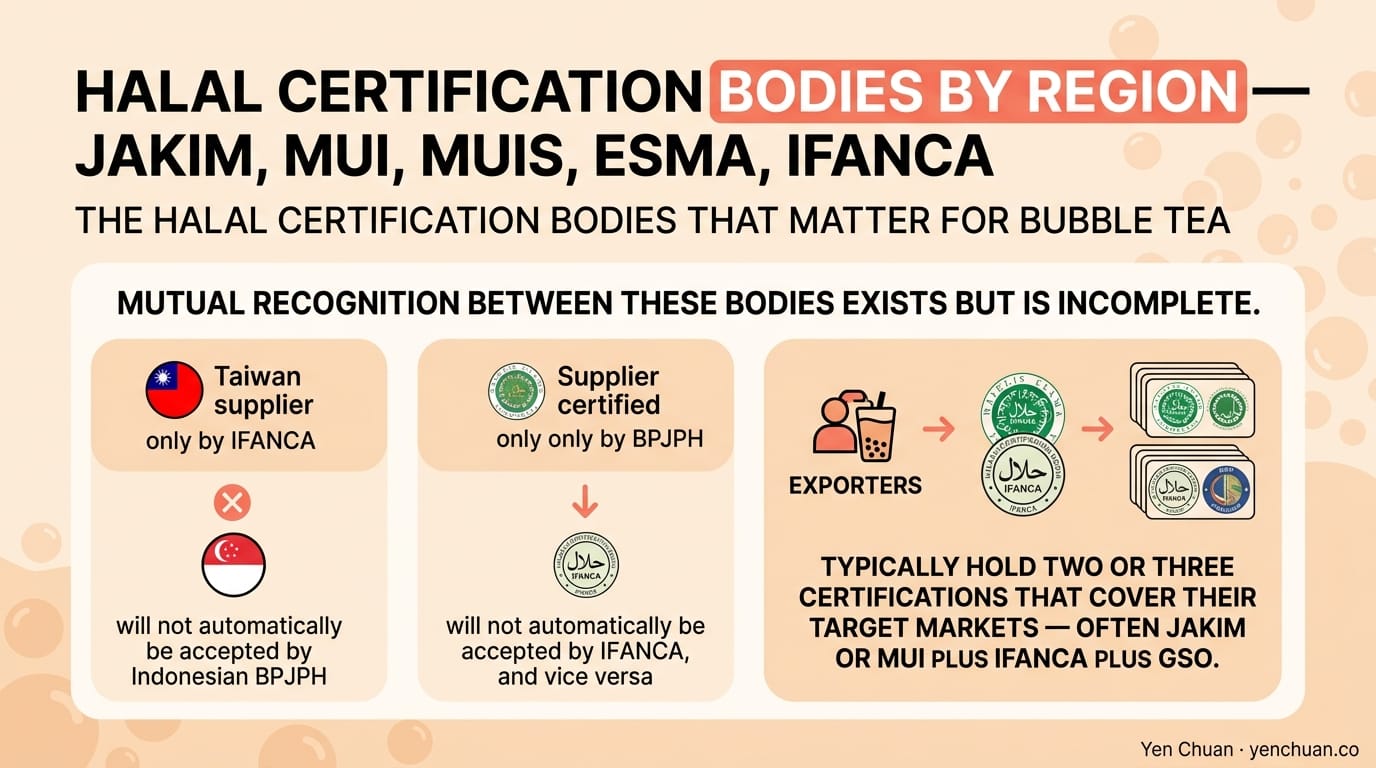
Mutual recognition between these bodies exists but is incomplete. A Taiwan supplier certified only by IFANCA will not automatically be accepted by Indonesian BPJPH, and vice versa. Mature exporters typically hold two or three certifications that cover their target markets — often JAKIM or MUI plus IFANCA plus GSO.
What a halal audit actually involves
Halal certification is not a paperwork exercise. It is a full on-site audit with a pre-audit documentation review, a physical inspection, employee interviews, and an annual renewal. The process for most major certifiers follows a similar seven-step pattern.
First, the supplier submits an application with a complete product list, ingredient specifications, facility layout, HACCP plan, and supplier documentation for every raw material. The certifier's auditors review the dossier for obvious non-compliance — gelatin from unverified sources, alcohol-based flavor carriers, pork-adjacent cross-contact risk.
Second, the certifier assigns a Muslim auditor (required under most major standards) who conducts an on-site visit. The audit typically takes one to three days for a mid-size ingredient facility. Auditors verify the incoming-materials register, the segregation of any non-halal lines, the cleaning and sanitation procedures between production runs, the packaging and labeling, and the storage and transport arrangements.
Third, the facility must prove there is no cross-contact between certified and non-certified product lines. A plant producing a single halal product line passes this step quickly. A plant producing both halal and conventional lines needs physical segregation — separate equipment where practical, validated sanitation cycles between runs where equipment is shared, and color-coded tools and containers.
Fourth, employee interviews and documentation training. Line staff must be able to explain the halal protocol at their station. Quality staff must show halal-specific training records.
Fifth, raw material traceability. The auditor traces a finished-product lot back through production records to the supplier receipts for every input. Any input without valid upstream halal certification becomes an audit finding.
Sixth, corrective action on any findings, usually with a 30-90 day window. Major findings block certification until resolved.
Seventh, certificate issue, typically valid for one year and tied to specific product SKUs and a specific facility. Re-audit annually. Any change — new ingredient, new SKU, new production line, relocated facility — triggers a mid-cycle review.
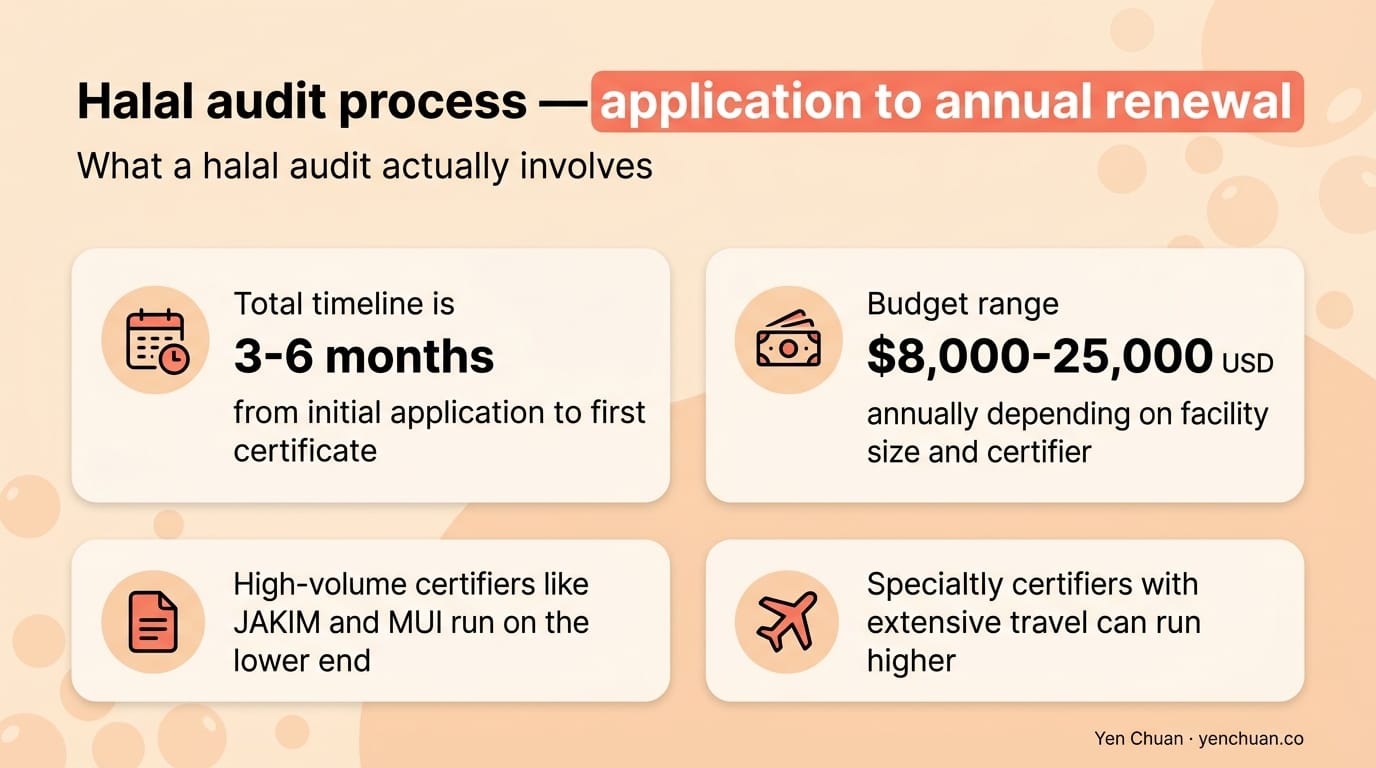
Expect total timeline of 3-6 months from initial application to first certificate, and budget $8,000-25,000 USD annually depending on facility size and certifier. High-volume certifiers like JAKIM and MUI run on the lower end; specialty certifiers with extensive travel can run higher.
Bubble tea ingredients that most often trigger halal issues
Even with a halal-certified supplier, a few bubble tea categories deserve extra attention at the purchase order stage.
| Ingredient | Common Halal Concern | Mitigation |
|---|---|---|
| Non-dairy creamer | Hexane solvent residues, carrier origin | Request halal COA for each lot |
| Flavor syrups | Alcohol-based flavor extracts | Spec water- or glycerin-based flavor carriers |
| Pudding / gelatin toppings | Porcine gelatin as default in some supply | Spec fish gelatin or agar-based, request certification |
| Milk powder / whey | Animal rennet in upstream dairy processing | Confirm microbial rennet at dairy source |
| Colorants | Carmine (cochineal, controversial in some schools) | Spec plant-based or synthetic alternatives |
| Processing aids | Non-disclosed carriers, release agents | Ask for a full ingredient declaration, not just the final product list |
Tapioca pearls are almost always halal-compliant by composition — tapioca starch, water, food-grade colorant. The certification still matters because the facility must demonstrate no cross-contact with haram-producing lines. For our tapioca pearl range, see the tapioca pearl catalog.
For non-dairy creamer specifically, the complexity is higher because the product category sits at the intersection of halal, kosher, and RSPO concerns. Our RSPO vs Non-RSPO creamer breakdown covers the palm oil side; the halal side requires the same supplier to hold an active JAKIM or MUI certificate for the specific SKU.
How to structure supplier documentation for halal markets
The practical rule for multi-market operators is to insist on certificate coverage that matches your end markets and to verify annually. Build the halal document stack into the supplier onboarding file alongside FSVP and the standard QA pack.
- Request the current halal certificate (PDF with registration number and expiry date)
- Verify the certificate status directly on the certifier's official website, not just the PDF — JAKIM, MUI, IFANCA all operate public verification portals
- Check that the SKU you are buying is explicitly listed on the certificate — a facility certification does not automatically cover every product made there
- Keep the certificate plus verification screenshot in your supplier file
- Re-verify each December or January for the following year's orders
For new market entries, talk to your Taiwan supplier before the audit cycle — most established manufacturers will add a missing certifier to their annual audit if the volume justifies it. Adding JAKIM to a facility already certified by IFANCA typically runs $5,000-10,000 incremental.
Our milk powder portfolio covers multi-certification buyers — see the RSPO-certified milk powder overview for the palm oil and dairy sides.
Authority Citations
- JAKIM — Department of Islamic Development Malaysia
- BPJPH — Indonesia Halal Certification Authority
- IFANCA — Islamic Food and Nutrition Council of America
- GSO 2055 Halal Standard
- DinarStandard — State of the Global Islamic Economy Report
About Yen Chuan
Yen Chuan has been at the heart of Taiwan's bubble tea industry for over 20 years, supplying premium powders, syrups, tapioca pearls, and tea leaves to thousands of boba shops worldwide. With an in-house R&D lab and a commitment to quality ingredients, Yen Chuan is more than a supplier — we're your partner in the boba business. We maintain active halal certifications covering our Southeast Asia and Middle East chain customers, with auditable supplier documentation on every lot we ship.
Looking for halal-certified bubble tea ingredients?
Need a Taiwan supplier with active halal certification for your SEA, Middle East, or US Muslim-market menus? Browse our ingredient catalog or get in touch to request our current halal certificates — we ship worldwide from Taiwan and can match any market's documentation requirements.
Frequently Asked Questions
Q: Which halal certification should a Taiwan supplier prioritize for bubble tea exports? A: For Southeast Asia, JAKIM (Malaysia) and MUI/BPJPH (Indonesia) are the priority. For the US, IFANCA is the dominant certifier. For the Gulf, GSO-recognized certification is required. Most chain-grade Taiwan suppliers hold 2-3 of these to cover their export markets.
Q: Are tapioca pearls halal by default? A: By composition, yes — tapioca starch, water, and food-grade coloring are all halal-compliant. However, certification is still required if the facility produces any non-halal products on shared equipment. Ask for a halal certificate naming the specific pearl SKU, not just the facility.
Q: How long does halal certification take and what does it cost? A: Initial certification typically takes 3-6 months from application to first certificate. Annual renewal is required. Budget $8,000-25,000 USD per year per facility, depending on the certifier, facility size, and number of SKUs covered. Volume certifiers (JAKIM, MUI) are on the lower end.
Q: Does a halal certificate cover every product made at the facility? A: No. Halal certificates list specific SKUs. A facility certification verifies the plant, but the commercial certificate must explicitly name each product the supplier is claiming. Always verify the SKU you are buying appears on the certificate document.
Q: Is alcohol-based flavoring allowed in halal bubble tea syrups? A: Most major halal standards prohibit ethanol-based flavor carriers above trace levels (typically 0.5% or less in the finished product, depending on the certifier). Spec water-based, glycerin-based, or propylene glycol-based flavor carriers to avoid the issue entirely.