The US bubble tea market is the fastest-growing regional market outside of China and Southeast Asia — but also the most regulated, the most distributor-driven, and the most price-sensitive at the retail shelf. Grand View Research estimates the US bubble tea market will pass $1.3 billion by 2027 at a high-single-digit CAGR. For Taiwan ingredient suppliers and international chains looking at the US as their next growth bet, the hard part is not demand — it is figuring out how to land containers at US ports, get those containers past FDA, get the inventory into a distributor network, and price the finished SKU so the shop can run the menu at a margin. This guide covers the three operational questions that matter most: distributor networks, FDA requirements, and pricing dynamics.
The US bubble tea market at a glance
Bubble tea retail demand in the US has tripled since 2018 and continues to compound. The IBISWorld bubble tea industry report identifies roughly 4,500 dedicated bubble tea shops in the US, with the three largest clusters in California (about 28% of total stores), New York and the Northeast (20%), and Texas plus the Southwest (15%). The remaining footprint is split across Florida, the Pacific Northwest, Chicago, and dozens of college-town markets.
That distribution matters because US ingredient logistics is not a single national market. West Coast shops buy overwhelmingly through Asian-American distributors operating out of Los Angeles, Oakland, and Seattle. East Coast shops buy through smaller regional distributors around the tri-state area and Atlanta. Texas and the Southeast are still comparatively under-served and often rely on direct-from-Taiwan buyers consolidating containers.
For a Taiwan ingredient supplier, the strategic question is whether to serve distributors wholesale (higher volume, lower margin, slower cash), sell direct to chain accounts (higher margin, more compliance work), or a hybrid. Most mature Taiwan exporters eventually run both, but the way you start usually decides your first three years in the market.
Distributor networks — the gatekeepers of the US market
The US bubble tea distributor landscape has around twenty significant players and hundreds of smaller ones. Most fall into one of three categories.
Large Asian-American ingredient distributors. Companies like Lollicup / Karat Packaging (publicly traded), Leadway, and TenRen have national warehousing networks, sales teams that serve thousands of independent shops, and private-label programs. They are the default channel for a Taiwan ingredient manufacturer looking to scale. Terms are tight: expect 35-45% margin to the distributor, net-60 payment, and exclusivity conversations after the first year.
Regional specialty distributors. Mid-size operators serving a metro cluster or a single state. Faster to onboard than the nationals, more relationship-driven, and often willing to trial new SKUs. Good for a Taiwan brand wanting to prove demand in a specific market before committing to a national distributor.
Chain-direct fulfillment. Some US bubble tea chains with 50+ stores run their own central commissary or import program. Getting on their approved vendor list is slow (6-12 months) but the economics are stronger because you bypass distributor margin. Examples include several of the largest US-based chains and franchised groups of Taiwan-origin brands.
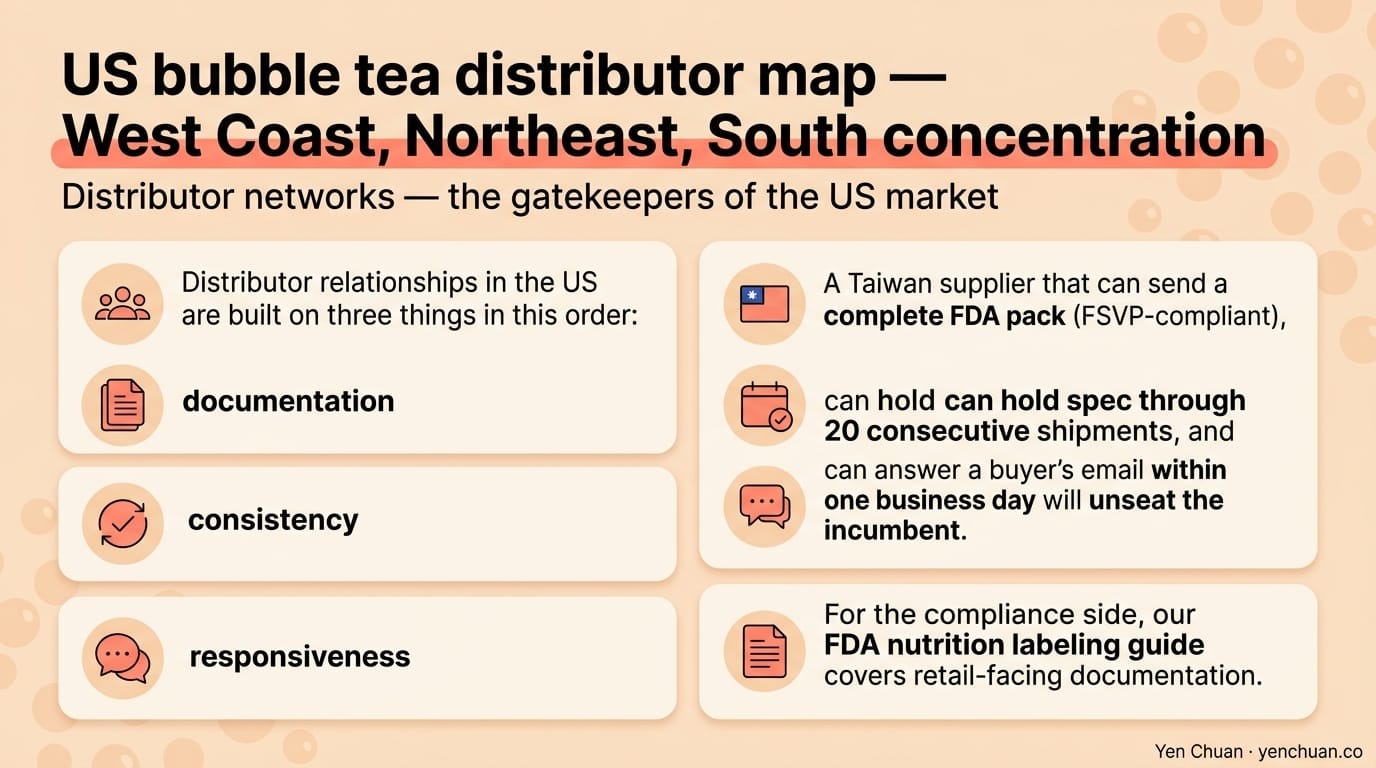
Distributor relationships in the US are built on three things in this order: documentation, consistency, and responsiveness. A Taiwan supplier that can send a complete FDA pack (FSVP-compliant), can hold spec through 20 consecutive shipments, and can answer a buyer's email within one business day will unseat the incumbent. For the compliance side, our FDA nutrition labeling guide covers retail-facing documentation.
FDA and regulatory requirements in plain language
US regulation of imported bubble tea ingredients has three operational layers. An exporter needs to satisfy all three to keep shipments moving.
FDA Food Facility Registration. The exporting facility must be registered with FDA under the Bioterrorism Act rules (renewed every even-numbered year). Registration is free and online, but an expired registration means every shipment from that facility is refused. Verify the registration status of your Taiwan supplier at least annually.
FDA Prior Notice. Every shipment of imported food must have a Prior Notice filed electronically before the goods arrive at the US port. The freight forwarder or customs broker usually handles the filing, but the supplier must provide complete lot information, product description, and FDA product codes.
FSVP (Foreign Supplier Verification Program). The US Importer of Record must maintain written records showing each foreign supplier produces food to hazard-control standards equivalent to US domestic rules. This includes hazard analysis, supplier evaluation, annual verification activity, and three-yearly re-evaluation. FSVP inspections happen at the importer's office and can trigger import alerts if records are incomplete.
Two additional FDA topics matter for finished-product importers. The Nutrition Facts panel is required on any packaged product sold at retail in the US, with specific format, font size, and rounding rules. For chains with 20+ locations, menu labeling rules require calorie disclosure on the menu board for in-shop prepared drinks. Neither applies to bulk ingredient imports sold B2B, but they apply the moment you private-label a retail SKU.
Customs adds one more layer — the Customs and Border Protection (CBP) clearance process, tariff classification under HTSUS, and any applicable anti-dumping duties. Most bubble tea ingredients fall into low-tariff HTSUS categories, but the 2024-2025 trade review cycles added scrutiny on select food categories, so confirm the HTSUS code and duty rate with your broker on every new SKU.
Pricing dynamics — what a container actually costs to land
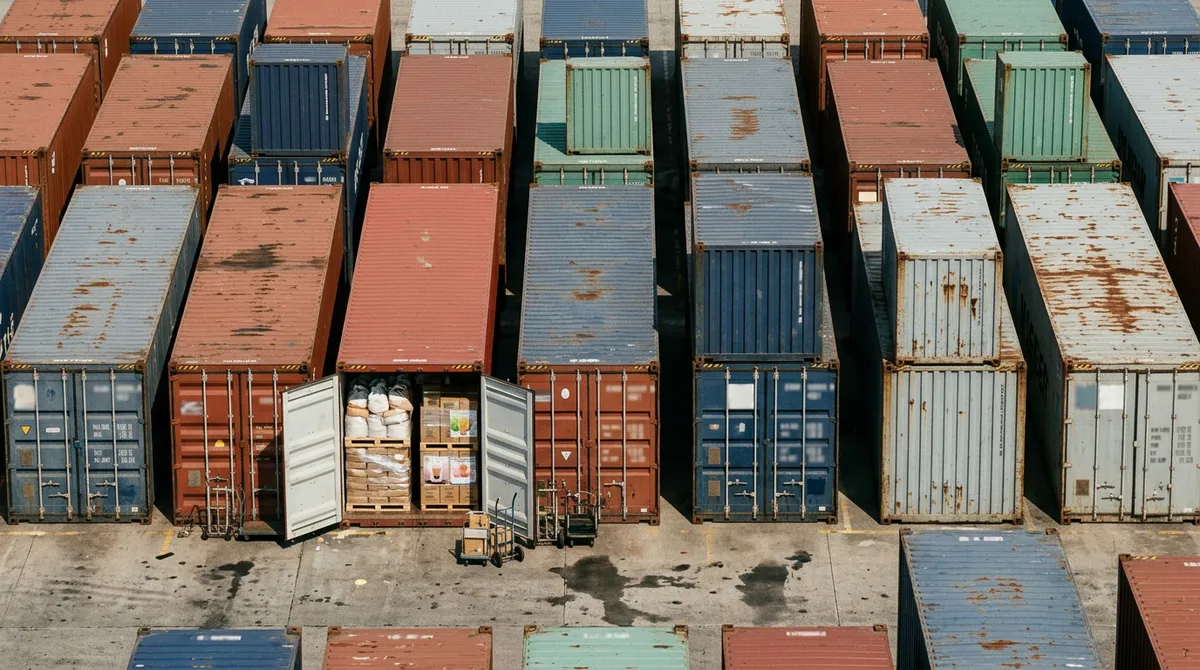
The biggest surprise for first-time Taiwan exporters to the US is that FOB price is only part of the story. A 20-foot container of bubble tea ingredients landed at Los Angeles and delivered to a distributor warehouse typically carries 30-45% of additional cost on top of FOB before the distributor even sets their own margin.
| Cost Component | Typical Share of Landed Cost | Notes |
|---|---|---|
| FOB Taiwan (product + port handling) | 55-65% | Base negotiation point |
| Ocean freight (Taiwan → LAX) | 8-15% | Rate volatile, depends on shipping window |
| Marine insurance | 0.5-1.5% | Required by most brokers |
| US customs duty (varies by HTSUS) | 1-6% | Low for most bubble tea ingredients |
| Customs broker + Prior Notice | 1-2% | Per entry, flat fee |
| Port handling + drayage to warehouse | 4-7% | LAX handling + trucking to local DC |
| Warehouse receiving + storage | 2-4% | First 30 days typically |
| Distributor margin | 35-45% | Before retail sale |
The implication: the FOB price a Taiwan supplier quotes and the price a US bubble tea shop actually pays are separated by a 2.0-2.5x multiplier in most cases. A $2.00/kg FOB tapioca pearl becomes $4.00-4.50/kg on the distributor invoice to the shop. Chains and distributors who understand this math negotiate tighter on FOB than volume-naive buyers who assume the gap is smaller.
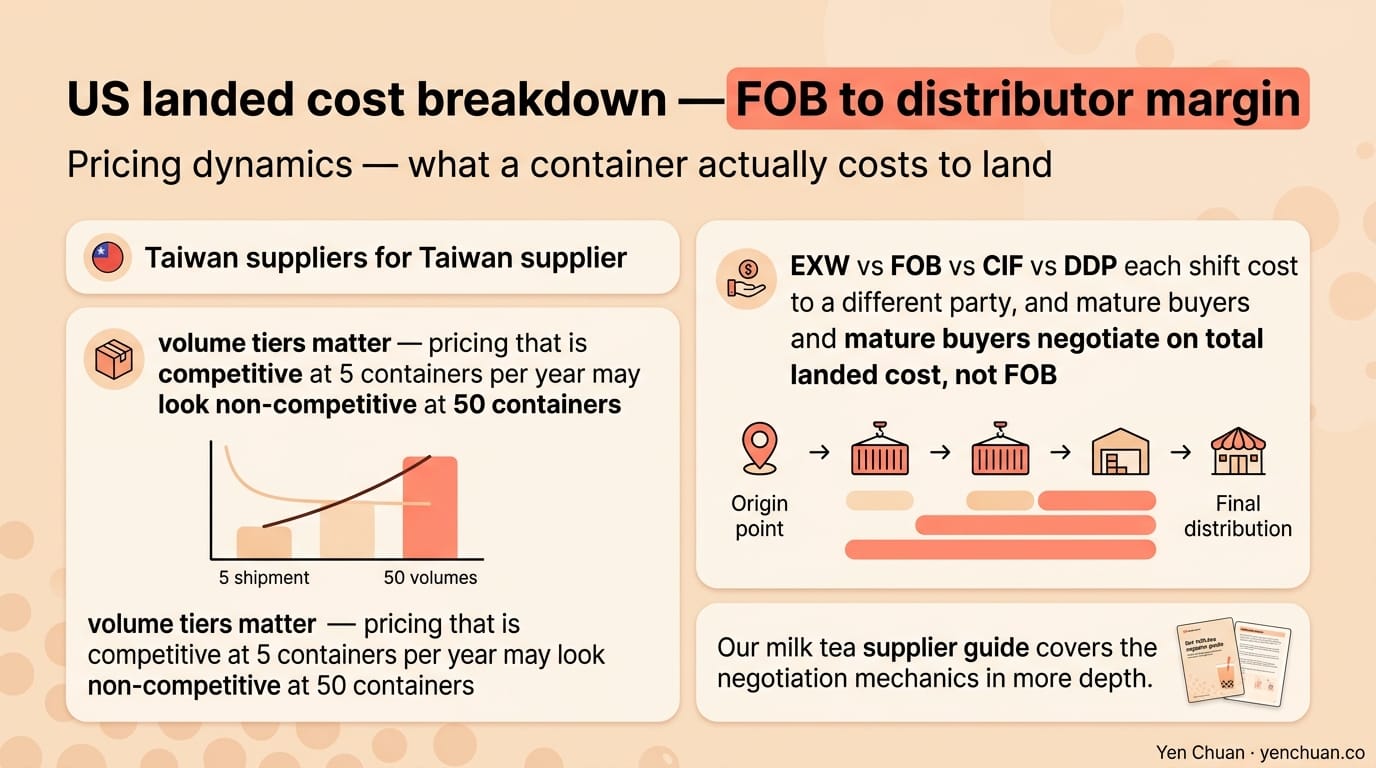
For Taiwan suppliers, this means two things. First, volume tiers matter — pricing that is competitive at 5 containers per year may look non-competitive at 50 containers. Second, EXW vs FOB vs CIF vs DDP each shift cost to a different party, and mature buyers negotiate on total landed cost, not FOB. Our milk tea supplier guide covers the negotiation mechanics in more depth.
Market entry playbook for Taiwan suppliers
A practical US market entry plan for a Taiwan bubble tea ingredient supplier with chain-level ambition usually runs through six stages.
First, pick the beachhead SKU. One or two hero products (usually tapioca pearls or a signature milk tea powder) that you can price aggressively and ship consistently. Trying to launch a full 50-SKU catalog simultaneously dilutes the sales effort and stretches the compliance stack.
Second, lock the compliance foundation. FDA Food Facility Registration, FSVP-ready document pack, COA on every lot, annual facility audit under SGS or Bureau Veritas. Have the compliance pack ready before approaching a distributor.
Third, pilot with a regional specialty distributor. Target one or two metros, offer a three- to six-month consignment or consignment-lite program, and measure actual sell-through. This is the market learning phase — what US buyers actually want, what gets returned, what compliance questions come up.
Fourth, build the national distributor conversation. Once you have proof of demand and eighteen months of clean compliance history, approach one or two national distributors with a volume proposal. Expect onboarding to take 4-6 months.
Fifth, add chain-direct customers selectively. Franchise groups and mid-size chains often prefer direct supply for their highest-volume SKUs. Target them after the distributor relationship is stable.
Sixth, invest in local support. Chains and distributors expect someone on US time zones answering emails. A dedicated US account manager or a partnership with a US-based agent becomes essential above a certain volume.
For chain operators and private-label buyers starting the reverse direction — importing from Taiwan — the same compliance stack applies, just with the importer of record responsibility sitting on your side. Our Taiwan vs China vs Southeast Asia sourcing comparison covers origin selection at a higher level.
Authority Citations
- Grand View Research — Bubble Tea Market Report
- IBISWorld — US Bubble Tea Shops Industry Report
- FDA Foreign Supplier Verification Program
- USDA Foreign Agricultural Service — US Import Data
- US Customs and Border Protection — Food Imports
About Yen Chuan
Yen Chuan has been at the heart of Taiwan's bubble tea industry for over 20 years, supplying premium powders, syrups, tapioca pearls, and tea leaves to thousands of boba shops worldwide. With an in-house R&D lab and a commitment to quality ingredients, Yen Chuan is more than a supplier — we're your partner in the boba business. Our US customers range from national distributors to franchise groups running direct import programs, with a standing compliance pack ready for any new account.
Ready to launch a US-ready supply line?
Evaluating a US market entry or scaling your existing US program? Contact our team for a sample compliance pack and pricing tiered to your volume, or browse our catalog — we ship worldwide from Taiwan with full US FDA documentation on every shipment.
Frequently Asked Questions
Q: How big is the US bubble tea market? A: Grand View Research projects the US bubble tea market will exceed $1.3 billion by 2027. IBISWorld counts roughly 4,500 dedicated shops, concentrated in California, the Northeast, and Texas. Growth is driven by Gen Z demand, chain expansion, and RTD beverage extensions.
Q: Do I need an American importer to bring bubble tea ingredients into the US? A: You need a US Importer of Record, but it does not have to be a separate legal entity. Many Taiwan suppliers partner with a US-based distributor who acts as the IOR. The IOR carries legal responsibility for FSVP, tariff classification, and Prior Notice.
Q: What FDA documentation is required for bubble tea ingredient imports? A: A valid FDA Food Facility Registration for the factory, Prior Notice before each shipment, a lot-specific COA, and FSVP records maintained by the US importer. Private-label retail SKUs also need a Nutrition Facts panel.
Q: What's the typical margin between FOB Taiwan and US retail shelf? A: FOB to distributor invoice usually runs 1.5-1.8x, and distributor to shop another 1.3-1.5x. A $2.00/kg FOB ingredient lands at $4.00-4.50/kg on a shop's purchase order.
Q: How long does it take to onboard with a major US distributor? A: For a national distributor, plan 4-6 months from first contact to first purchase order. Regional distributors can move in 2-3 months. Chain-direct accounts with 50+ stores run 6-12 months.